
Rethinking school inspections
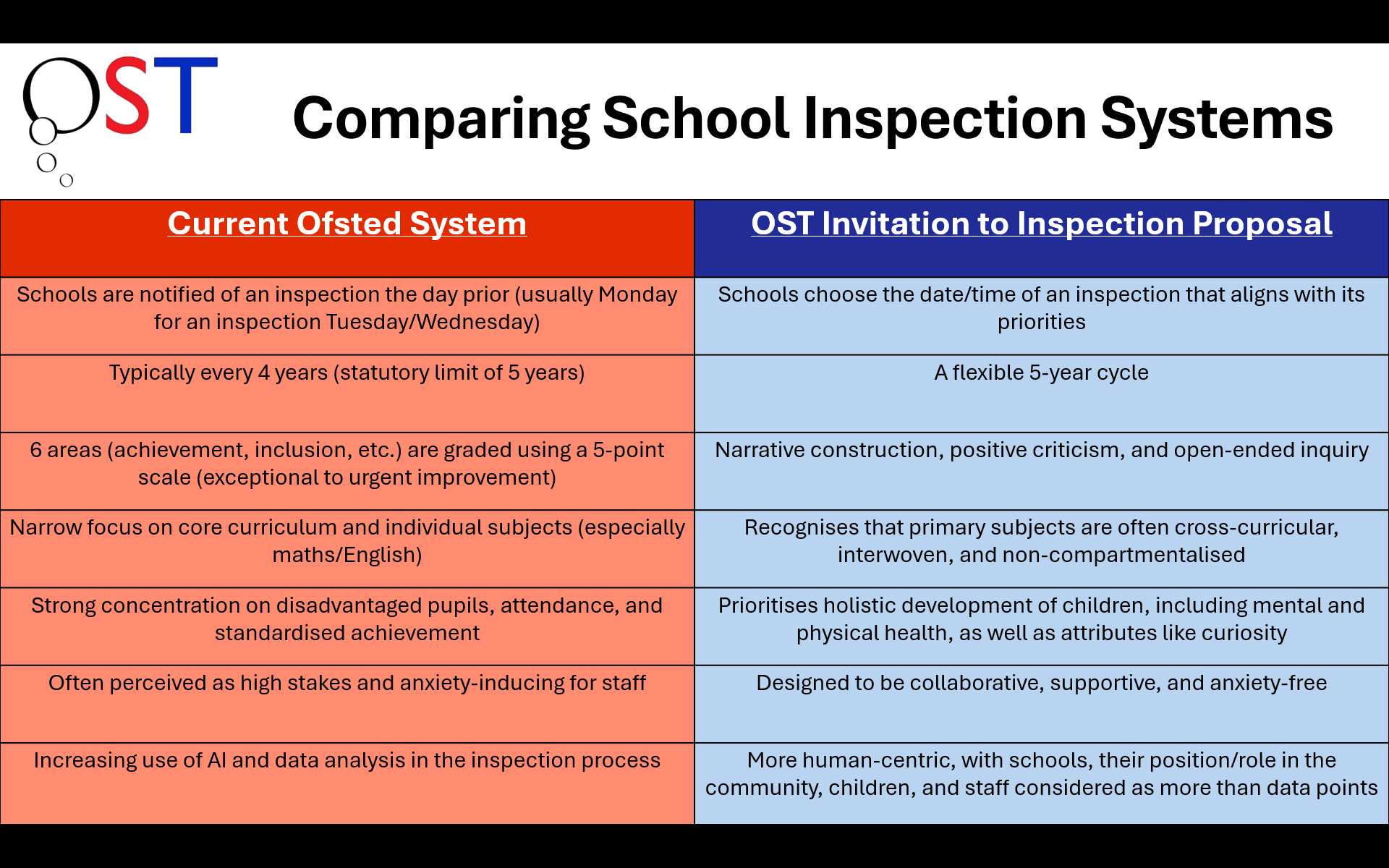
Imagine being in a school that welcomed Ofsted with open arms. No fear, no resentment, no nasty surprises. An opportunity to show how good your school is and engage in professional discussion concerning areas for improvement; getting an offer of advice where needed. An explicit demonstration that inspection is done for the benefit of children. This is the model we, at The Oxford School of Thought, propose in our recent paper Invitation to Inspection in Primary Schools. We say “This will require a fundamental shift in the dynamic, from a high-stakes, compliance-driven process, to a collaborative, school-initiated model that reflects the true purposes of primary education.”
There is a rift in the relationship between schools and Ofsted with a very apparent lack of trust on both sides. The way to mend this rift is not to take legal action or to call for the abolition of the inspection regime; all good schools welcome the need for accountability, want to share their successes, and receive advice aimed to improve their practice. But there is currently an atmosphere of fear that drives school leaders to comply with a framework that takes insufficient account of the complexity of educating individual children or the community in which they live. There is extra stress involved, particularly for small primary schools, before inspection with regards to time, workload, and expense, while better resourced, larger schools can buy-in consultancy so that they are better defended. This is money which would be better spent improving the learning and wellbeing of children.
A hallmark of any worthwhile institution, organisation or business is its ability to self-evaluate and hold itself accountable. Primary schools have already embraced this through using the annual school evaluation form (SEF) for many years. A shared quest for improvement should drive the inspection agenda within every school. Our proposal is simple; schools will make good use of their self-evaluation process and choose the time in a five-year cycle when they wish to invite Ofsted to visit the school. This would immediately change the dynamic. Inspectors would be welcome guests, discussions would be held between peers, the outcome would be a positive, honest, reflection of the school and a sense of integrity and satisfaction for the inspectors.
Another issue which needs to be addressed – and is a common thread throughout the years of Ofsted inspections – concerns the inconsistency of lead inspectors and their teams. There are questions around the training of the current teams, their expertise relevant to the phase and context of the schools they inspect. Perhaps, too, after a period of time, inspectors should have brief sabbaticals in schools to reacquaint themselves with the realities of working with children and teachers. The issue of recruitment of inspectors then arises. Who should they be and what experience should they have? Should they be selected by a panel of their peers who will have a better chance of filtering the best candidates into the system? We propose that the majority of inspectors of primary education must be drawn from primary teachers and headteachers who would see this role as part of their professional development and career progression. Some might choose to become an inspector towards the end of a successful career in schools, seeking a new challenge and refreshment. Such people would bring experience, expertise and perspective to the inspection process, being also well acquainted with the pressures of school life.
A CALL FOR CHANGE
In a previous paper we called for a developmental and collaborative inspection model based on primary school characteristics, shifting away from punitive oversight and encouraging a shared quest for continuous improvement. We argued that inspections should celebrate success, engage in professional dialogue, recognise the complexity of primary teaching, and focus on children’s holistic development across the whole curriculum.
In Invitation to Inspection in Primary Schools, we propose a fundamental shift from high-stakes, compliance-driven inspections to a school-initiated model that better reflects the true purposes of primary education. We believe this approach, in which inspection is part of a long-term professional and collaborative approach to school improvement based on self-evaluation, would help to restore confidence of the profession.
This is a call for open-ended enquiry, richer assessment practices, and context-sensitive judgements, supported by a revitalised advisory network. By establishing relationships based on trust, expertise, and shared accountability, inspections can become constructive, empowering experiences that promote sustained school improvement and wellbeing for children, teachers, and leaders. In adopting these proposals Ofsted might become a challenge and support for schools that could be welcomed with open arms.